
Reengaging History: An Interview Feature with Manahil Bandukwala about MONUMENT
Sneha Subramanian Kanta: We’ve known the work of each other since 2017, and I’m delighted to share this space to converse about your debut collection MONUMENT. Congratulations, Manahil. How have these past months been for you?
Manahil Bandukwala: It’s wonderful to speak with you as well! These past months have been busy the way the life of a freelance writer/artist typically is. I’m constantly working on projects, and this year wrapped up some big ones, as well as set new ones in motion. This in-between space I’m in has been a good chance to try out new forms of art and writing. It all feels very experimental at this point.
Sneha: You rework history through the poems in MONUMENT. This is achieved through intentional syntax. I want to bring attention to the inverted illustrations of the Taj Mahal and a slow chipping away until a pile of rubble. I’m aware of the fact that you work in several mediums. In what ways did incorporating this visual impact influence you?
Manahil: I’m a visual artist in addition to a writer, and wanted to incorporate some sort of visual element to divide the sections and produce a narrative flow. The drawings actually came last, and the decision to include them emerged out of conversations with my editor, after the bulk of the editing was completed.
The Taj Mahal is an iconic building and is instantly recognizable. To draw it inverted literally turns it and its cultural significance on its head, which is what the book does. I had also known from the beginning that I didn’t want the Taj Mahal to appear on the cover itself, so having it appear on the inside pages felt significant and important to me.
Sneha: You seek to deconstruct the myths surrounding empire through the poems. In “1622”, the lines “In our cold bed I pulled back my lips from your ear— / can we plant an empire such as this one // where I would love you in golden hour every minute / of every remaining day” embody a multilayered quality of belonging and what romance would mean under empire. In “1628”, the lines “You wanted to shape me // into empire, build me an empire.” are vivid in the amalgamations of violence. Would you share if you had a specific methodology towards writing this book, especially in undertaking the historical research?
Manahil: The book began slowly and unintentionally. I spent a great deal of time researching through both digital articles as well as in the library stacks of my university. I read about Mumtaz Mahal (and the history around the Taj Mahal, since there wasn’t too much about Mumtaz Mahal herself).
As I read, ideas for poems—or more accurately, questions—formed. I wrote as I researched, then edited, then researched more, then edited again. As I researched more, the poetic diction took a firmer and more assured stance, I would say. Assuredness in my own methodology, in my perspective on this.
It was especially interesting working on this book alongside my university degree. For my courses, research had to be very specific and had to have a tailored purpose towards the subject. MONUMENT then felt like a breath of fresh air, where there were fewer rules with how the research had to appear in the poetry. I wasn’t writing for a grade, but rather for myself.
Sneha: In the section titled “Offspring”, there is a litany of descendants in the family. You dedicate a poem to specific family members, outlining their lived experiences. The storytelling is terse and effective. From a craft standpoint, what was the idea in including this alluring section?
Manahil: Because Mumtaz Mahal’s legacy is a product of her death, which in turn is so strongly linked to the maternal health conditions she lived through, it wasn’t possible to not write about her children and legacy. The visual poem that opens “Offspring” shows just how many children she had, and shines a light on how less than half lived into adulthood.
The poems for specific family members spotlight the most significant offspring who had a firm role to play in history. As part of my research, I read literature that featured Mumtaz Mahal as well. Her children made appearances in these novels, and in some cases were the complete focus. The question of legacy, especially a gendered legacy in how we remember not only Mumtaz Mahal but her children as well, was important to me, and so this section came about.
Sneha: In the section titled “Last Words” you carry a question mark. This section is fascinating for the elements of intrigue it brings to the reader. You include a paragraph and then slowly begin by bringing emphasis to certain words outlined in bold. They read as fractures: in our understanding of time, geography, space, and history. There is a steady construction towards vocabulary but also a dismantling of it. How did this section begin to build?
Manahil: “Last Words” is where the collection leans into speculative aspects. When I first read the recorded last words of Mumtaz Mahal, I was left sceptical that these could be her actual last words as she lay dying in childbirth. I played around with different ways to express my own reaction to finding out this bit of information through poetry. The erasures are what I landed upon—showcasing her words interspersed with my own imaginings.
Sneha: In the poem with the title as your name, “Manahil”, there is an ardent flow. Manahil “means spring water”. There is a recurrent passage of interweaving in the poem. How did this poem arrive to you?
Manahil: The poem “Manahil” arrived as I was reading Irfan Ali’s “Accretion,” which includes the poem “Irfaan.” I was drawn to the idea of a poet interjecting their own name into a poem. Given the thematic arc of MONUMENT, it felt appropriate to close the book with twinned poems, “Manahil” and “Mumtaz.” Often in poetry it is left unclear whether the speaker is the poet, but in this case the speaker and the poet are the same. This poem impresses upon a reader that the entire book is as much as a linked relationship between myself and a historical figure as it is about the historical figure alone.
Sneha: Thank you so much, Manahil.
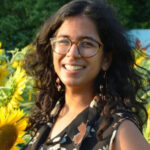
Manahil Bandukwala was born and raised in Karachi and is currently a settler on unceded Algonquin and Anishinaabe territory (Ottawa). She holds a BA in English from Carleton University and an MA in English at the University of Waterloo. Her 2024 poetry collection Heliotropia was the winner of the Archibald Lampman Award for Poetry. She is currently Managing Editor at Brick Books, and on the board of Canthius.